
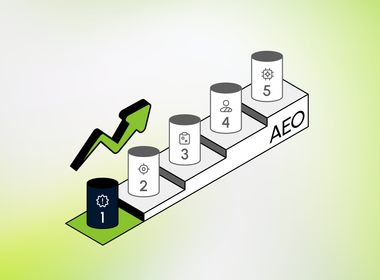
What Is Stage 1 of the AEO Maturity Matrix? A Guide to Reactive AEO
Stage 1 of the AEO Maturity Matrix—Reactive—is where most organizations begin their AI search journey. Teams recognize the importance of AEO, but efforts are still manual, inconsistent, and spread across disconnected people, processes, metrics, and tools.
How to move beyond Reactive AEO:
- Establish ownership with clear roles and responsibilities for AEO.
- Create repeatable workflows that align SEO and content teams around a shared strategy.
- Evaluate the right AEO platform to replace fragmented workflows with connected insights that can scale alongside your program.
- Measure AI visibility by tracking foundational metrics like citations, mentions, and market share.
Ask 10 marketing teams where they are in their AEO journey, and you'll probably get 10 different answers.
Some are publishing AI-optimized content. Others are measuring citations or have invested in new AI visibility tools. The majority are still trying to understand what AEO should look like for their business.
The challenge isn't that organizations aren't taking action. It's that they often lack a clear framework for understanding what progress actually looks like.
That's why we created the AEO Maturity Matrix.
The AEO Maturity Matrix is a framework for assessing how mature your organization's AEO strategy is across four core pillars: people, process, metrics, and tooling. It helps you identify where you are today, what's holding you back, and the next steps to build a more effective, repeatable AEO program.
This article is the first in a five-part series exploring each stage of the AEO Maturity Matrix. Here, we'll focus on Stage 1: Reactive, where most organizations begin. If your AEO efforts feel manual, disconnected, or driven by immediate priorities instead of a documented strategy, you're probably here.
And that's okay.
Stage 1 is the starting point. The goal isn't to skip ahead. It's to build the right foundation so your team can confidently progress to Stage 2 and beyond.
Stage 1 of the AEO Maturity Matrix: Reactive
Reactive AEO is where most organizations begin their AEO journey.
At this early stage, teams understand that AI search is changing how customers discover and evaluate brands, but their approach to AEO is still largely reactive. Instead of following a documented strategy, they are responding to immediate needs, experimenting with new tactics, and adapting as the search landscape evolves.
This often results in disconnected efforts across SEO, content, and web teams. Content may be optimized for AI search on a case-by-case basis, new tools are evaluated independently, and success is measured inconsistently. As a result, it's difficult to understand what's driving AI visibility or where teams should focus their efforts next.
That doesn't mean your organization is behind. In fact, these early experiments are an important part of the learning process, and many organizations are in the same position. The challenge is turning those individual efforts into a coordinated, repeatable strategy that can scale over time.
Every mature AEO program starts somewhere. In Stage 1, the focus is on developing the structure needed to move from reactive execution to a more operational approach.
The AEO Maturity Matrix evaluates every stage across four core pillars:
- People: Who owns AEO, and how teams are organized.
- Process: How AEO work is planned, prioritized, and executed.
- Metrics: What success is measured against.
- Tooling: The technology supporting AEO workflows and decision-making.
Together, these four pillars provide a framework for evaluating your current maturity and identifying the changes needed to progress to Stage 2.
What Stage 1 looks like across the four AEO maturity pillars
Organizations don't remain in the Reactive stage because of a single challenge. Instead, Stage 1 is defined by common patterns across people, process, metrics, and tooling.
People
In Stage 1, AEO is often siloed across teams or is outsourced to an agency. SEO practitioners, content marketers, and web teams may all contribute to AI visibility, but responsibilities are often informal, and collaboration happens on an as-needed basis.
Without shared ownership and clear collaborative processes in place, AEO initiatives tend to depend on individual contributors rather than a shared organizational strategy. Knowledge is siloed, with teams still learning how AI search works and what it means for their day-to-day responsibilities.'
Example: An SEO manager may identify an opportunity to improve AI visibility, but content, development, and analytics teams aren't aligned on who should take ownership or how success will be measured.
Process
Most Stage 1 organizations don't have a documented AEO workflow. Instead, work is driven by immediate priorities, new AI developments, or one-off optimization requests.
SEO and content teams may collaborate on individual projects, but planning isn't yet built around a shared AEO strategy. As a result, efforts are difficult to repeat, scale, or consistently improve over time.
Example: A content team updates a handful of pages after noticing competitors appearing in AI-generated answers, but there isn't a repeatable process for identifying, prioritizing, and optimizing similar opportunities across the rest of the site or measuring the impact of those updates.
Metrics
Measurement is often one of the biggest gaps in Stage 1.
While teams may track traditional SEO metrics such as rankingsRankings
Rankings in SEO refers to a website’s position in the search engine results page.
Learn More, clicks, and organic traffic, they have limited visibility into AI search performance. Metrics like AI citations, mentions, and market share are either tracked inconsistently or not measured at all, making it difficult to understand what's influencing AI visibility.
Example: A team knows organic traffic increased after publishing new content, but they can't determine whether their brand is appearing more frequently in AI-generated answers or being cited by LLMs.
Tooling
The technology stack in Stage 1 is often fragmented. Teams rely on spreadsheets, point solutions, manual research, and disconnected reporting to understand traditional search performance—but they have little to no visibility into how they're performing in AI search.
Without the right tools to track AI citations, mentions, and overall visibility, it's difficult to know what's working, identify opportunities, or measure progress over time.
Example: An SEO manager gathers keyword data from one tool and technical insights or traffic analytics from another before creating a report. The disconnected workflow slows decision-making and makes it harder to identify meaningful opportunities.
Common challenges in the Reactive AEO stage
Many organizations don't realize they're in the Reactive stage until they start trying to scale their AEO efforts. That's when gaps in ownership, workflows, measurement, and technology become much more difficult to ignore.
Challenge #1: Progress stalls
Stage 1 organizations are actively experimenting with AEO, but those efforts often happen independently rather than as part of a coordinated strategy. Without clear ownership, documented workflows, or shared priorities, it's difficult to build on early successes or apply what teams learn across the organization.
Challenge #2: Limited visibility leads to missed opportunities
Many teams still rely on traditional SEO metrics to evaluate performance, leaving them with little insight into how their brand appears in AI-generated answers or how they compare to competitors. Without a reliable way to measure AI visibility, it's difficult to identify opportunities, prioritize work, or demonstrate the impact of AEO initiatives.
Challenge #3: Reactive execution becomes harder to sustain
Responding to individual AI search changes or optimizing content one page at a time may work in the early stages, but those approaches become more difficult to maintain as competitors’ AI search market share grows and the performance gap widens. Fragmented workflows and disconnected tools create unnecessary manual work, slowing decision-making and making it harder to adapt as AI search continues to evolve.
The good news is that these challenges are exactly what Stage 2 is designed to address. By strengthening your people, processes, metrics, and tooling, you can build a more consistent, scalable approach to AEO.
How to move from Reactive to Operational AEO: Actionable strategies
If Stage 1 is about learning, Stage 2 is about turning those lessons into action with a structured, repeatable approach to AEO.
You don't need to overhaul your entire AEO strategy overnight. Small, deliberate improvements across your organization can create the structure needed to scale your efforts with confidence.
The following recommendations will help you improve the people, processes, metrics, and technology needed to reach Stage 2.
1. Strengthen your people strategy with clear AEO ownership & collaboration
As AEO becomes a larger part of your marketing strategy, clear ownership becomes increasingly important. While multiple teams contribute to AI visibility, someone needs to be responsible for setting priorities, coordinating efforts, and keeping initiatives moving forward.
Start by creating a simple AEO ownership plan. It doesn't need to be complicated, but everyone should know who is responsible for each part of the workflow.
For example, document who will:
- Set the overall AEO strategy and priorities.
- Identify content opportunities and optimization recommendations.
- Create or update content.
- Implement technical SEO recommendations.
- Track performance and share results with stakeholders.
Next, identify one or two internal champions who can help educate the broader organization on AEO best practices and encourage collaboration across SEO, content, web, and analytics teams.
Finally, establish a recurring planning meeting between SEO and content teams to review AI visibility insights, prioritize opportunities, and assign next steps. A simple monthly cadence is often enough to build alignment without creating unnecessary overhead.
If gaining executive buy-in is your biggest challenge, our Enterprise AEO Pricing Guide can help you build the business case for investing in AEO.
2. Build repeatable processes
One-off optimizations can produce quick wins, but they rarely lead to long-term progress. Instead of reacting to every change in AI search, focus on creating a more proactive workflow your team can repeat consistently.
A simple process might look like this:
- Build a regular process for identifying opportunities to improve AI visibility.
- As opportunities arise, prioritize based on business impact.
- Assign ownership.
- Optimize or create the content.
- Measure the results.
- Document what you learned.
Once that workflow is working consistently, expand it to additional content types, business units, or websites.
Conductor Creator can help support this by combining content research, a purpose-built AI Writing Assistant, custom Content Profiles, Knowledge Sources, and optimization into a single, unified workflow.
3. Start measuring what matters
Many organizations try to build a comprehensive AEO reporting framework from day one. Instead, start by creating a baseline you can build on over time.
Choose a small set of metrics that align with your goals, such as:
- AI citations for your highest-priority topics
- AI mention market share compared to your top competitors
- Organic and/or AI referral traffic and conversions for pages you're actively optimizing
Review those metrics consistently—monthly or bi-weekly is a good starting point—and use the insights to prioritize next steps rather than simply reporting on performance.
4. Evaluate and invest in the right AEO tool
Before evaluating vendors, document the challenges you're trying to solve. This helps ensure you're choosing an AEO solution based on your organization's needs rather than a checklist of features.
Start by asking questions like:
- Which AEO tasks are still manual?
- Where are teams duplicating work?
- Which AI visibility metrics can't we measure today?
- Which systems or data sources need to work together?
Then compare AEO tools based on how well they support your workflows today and how viable they will be as your AEO program matures. Look for capabilities like AI visibility measurement, intelligent content optimization, technical monitoring, connected reporting, and collaboration across teams.
Not sure where to start? Our AEO Tool Comparison Hub can help you compare leading enterprise AEO tools, understand key evaluation criteria, and evaluate how different solutions align with your organization's goals.
How to know your organization is ready for Operational AEO
There's no single milestone that marks the transition from Stage 1 to Stage 2. Instead, organizations gradually build the capabilities needed to support a more operational approach to AEO.
Stage 2, Operational, is where AEO becomes a repeatable part of your marketing strategy. Teams have established clear ownership, documented workflows, foundational AI visibility measurement, and connected technology that helps them execute more consistently.
If you can answer yes to most of the questions below, you're likely ready to move into Stage 2 of the AEO Maturity Matrix:
- Is AEO ownership clearly defined across your SEO and content teams?
- Do your SEO/AEO and content teams collaborate through a shared planning process rather than working independently?
- Does your team have a documented workflow for identifying, prioritizing, optimizing, and measuring AEO opportunities?
- Are you consistently measuring AI visibility using metrics such as citations, mentions, or AI Market Share?
- Do you regularly monitor technical website health and AI crawlability?
- Does your technology support connected workflows instead of disconnected point solutions and manual reporting?
- Do you regularly review AEO priorities and use those insights to guide future optimization efforts?
If you're still working toward several of these capabilities, don’t worry. The goal isn't to check every box at once. Every improvement brings your organization closer to a more scalable, authority-first AEO program.
Looking for a deeper dive into AEO? Explore the AEO Handbook for practical guidance, best practices, and strategies to help you build and scale your AI search program.
FAQs about Reactive AEO
Reactive AEO is the first stage of the AEO Maturity Matrix. At this stage, organizations recognize the importance of AI search but haven't yet established a consistent strategy for managing it. AEO efforts are often manual, siloed across teams, and driven by reactive fixes rather than repeatable processes.
Yes. Most organizations begin their AEO journey in the Reactive stage. It's a natural starting point for teams that are experimenting with AI search, learning how it affects their business, and beginning to establish the people, processes, metrics, and technology needed to scale their efforts.
The biggest difference is consistency. In Reactive AEO, work is largely reactive and handled through individual initiatives or one-off optimizations. In Operational AEO, organizations establish clear ownership, repeatable workflows, foundational AI visibility measurement, and connected technology that supports a more operational approach.
Start with ownership and governance. Defining who is responsible for AEO, documenting repeatable workflows, establishing a baseline for AI visibility, and evaluating your technology stack will create the structure needed to scale your program over time.
There's no universal timeline. Progress depends on your organization's size, resources, and existing SEO maturity. Rather than trying to reach the Operational stage all at once, focus on making steady improvements across people, process, metrics, and tooling. As those capabilities become more consistent, your AEO program will naturally mature.
Moving beyond Reactive AEO
The organizations that succeed in AI search won't be the ones reacting every time they disappear from an AI Overview or aren't mentioned in a single AI-generated response. They'll be the ones who build repeatable ways of adapting as search continues to evolve.
That's exactly what the AEO Maturity Matrix is designed to help you do.
Lasting progress comes from improving the fundamentals first. The stronger your foundation, the easier it becomes to build, measure, and refine your AEO efforts as they grow. That's how you reach AEO maturity.