
SEO vs. AEO: What’s Changed, What Hasn't, and What to Do About It
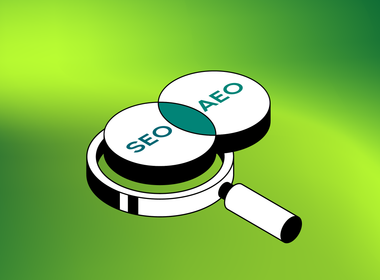
The debate between SEO and AEO is a false choice. AEO (answer engine optimization) builds on SEO rather than replacing it, and the core pillars that drive traditional search performance are the same ones that determine whether your content gets cited in AI answers. Stop choosing between the two and start building for total visibility through unified strategies.
Every digital leader is asking their team the same question right now: Should we be doing AEO instead of SEO?
Some are treating AEO as the next evolution of SEO. Others are treating it like a replacement. Most are trying to figure out how much to change, and how fast.
But the question itself is a false choice. SEO and AEO aren't competing for your budget or attention. They're two channels serving the same goal: getting your brand in front of people wherever they're looking for answers.
Visibility is the north star, and SEO and AEO are the two engines that help you achieve it.
Let’s break down what has actually changed about search, what hasn't, and how to unify SEO and AEO strategies so you can build on the search foundation you already have.
The SEO vs. AEO debate is asking the wrong question
The one or the other framing keeps teams stuck, and it's worth understanding why.
The problem with that approach is that it shouldn’t be one or the other.
![Patrick Reinhart, VP, Services and Thought Leadership, [object Object]](https://cdn.sanity.io/images/tkl0o0xu/production/9bc72298b24ad01b732de4c3376f79546d20f81c-3542x3542.png?fit=min&w=100&h=100&dpr=1&q=95)
A lot of people get confused and think you have to throw SEO out and only do AEO. You need to do both because both play into one another. If you do well in SEO, you typically do well in AEO and vice versa.
Ultimately, you're still trying to do the same thing: create great content that answers questions, maintain a strong technical foundation, and increase your authority.
These two channels will live and die with each other. Leaders should focus on alignment rather than arguing about it.
The foundation SEO builds—authority, technical health, and content depth—overlaps significantly with what AEO runs on. Treating them as separate problems means rebuilding something you've already invested in and jeopardizing that foundation in favor of a pivot to AEO.
Leaders need to stop asking "SEO or AEO?" and start asking "Are we visible wherever our audience is looking for answers?"
That shift in thinking changes the entire approach. Instead of managing two separate strategies, teams start building toward a single goal: earning visibility across every surface that matters, from traditional SERPs to AI Overviews to answer engines like ChatGPT, Claude, and Perplexity.
The SEO foundations that drive AEO performance
Once you stop treating SEO and AEO as separate strategies, the next question becomes: what actually drives visibility across both?
The answer is the same foundation you’ve already been building.
Technical health, content quality, and authority signals are what determine whether your content gets surfaced. Those signals don’t change depending on where the content appears. They shape what shows up in a ranked result on traditional SERPs and what gets pulled into an AI answer.
Technical health is table stakes for SEO and AEO
If your site isn’t accessible, it won’t show up. Anywhere.
Search engines and AI crawlersCrawlers
A crawler is a program used by search engines to collect data from the internet.
Learn More both rely on the same baseline signals to discover and surface content. Page speed, mobile experience, crawlability, and clean site architecture aren’t SEO best practices in isolation; they’re prerequisites for visibility across every search surface.
AI crawlers may operate differently from Googlebot, but they still need structured, accessible pages to understand your content. If key information is buried behind technical barriers, slow load times, or inconsistent rendering, it won’t get picked up, ranked, or cited.
E-E-A-T: The currency AI answer engines run on
Trust has always been the backbone of SEO. Now it’s the filter for whether your content gets used at all.
Google codified E-E-A-T, experience, expertise, authoritativeness, and trustworthiness, as a way to evaluate content quality. AI answer engines follow the same principles, even if they don’t explicitly name them.
When an AI model generates a response, it’s not pulling from just anywhere. It prioritizes sources that are credible, consistent, and authoritative. That means your brand, your authors, your owned content, and offsite or third-party content all play a role in whether you’re included.
This is where a lot of AEO strategies miss the mark. There’s no shortcut to becoming a trusted source. The same long-term investments that build authority in SEO, expert-driven content, original research, and strong brand presence are what determine whether you get cited in AI answers.
Intent alignment remains critical
There’s a tendency to frameFrame
Frames can be laid down in HTML code to create clear structures for a website’s content.
Learn More AEO as a shift away from keywords, but that oversimplifies what’s actually happening.
Search has always been about intent. Keywords were just a proxy for understanding it.
Now, both search engines and AI platforms are better at interpreting context, nuance, and user goals. That means content that clearly and completely answers the question ad aligns with the primary search intent wins, regardless of how the query or prompt is phrased.
This shows up in longer, more conversational queries and more specific expectations from users. People aren’t just searching for “best CRM.” They’re asking LLMs, “What’s the best CRM for a mid-sized B2B team with a small sales ops function?”
Content that matches that level of specificity and aligns with the intent and user persona is what earns both rankingsRankings
Rankings in SEO refers to a website’s position in the search engine results page.
Learn More and citations. Content that misses it doesn’t perform in either channel.
Content structure: How you get cited, not just ranked
Getting ranked on page one is no longer the primary goal of content. Being discoverable and able to be parsed by LLMs is just as important as being readable by humans.
AI systems don’t just evaluate what your content says. They evaluate how it’s structured. They look for direct, scannable structure, concise explanations, and chunkable sections that can be extracted and repurposed into answers.
That means content structure becomes a competitive advantage.
Content that leads with direct answers, uses clear heading hierarchy, and breaks ideas into logical, chunkable sections is easier to parse and more likely to be surfaced. On the other hand, content that buries the answer, relies on long-winded intros, or favors walls of text over well-organized heading hierarchy becomes harder to crawl and less likely to be viewed as citation worthy—even if the information itself is strong.
This isn’t a new discipline. It’s what good on-page SEO has always required.
The difference is that structure now determines not just whether you rank, but whether you’re cited.
What's new with AEO (and what isn't)?
Nailing the fundamentals of SEO is non-negotiable. But AEO has introduced its own set of rules that go beyond what traditional search programs were built to handle.
From a tactical standpoint, there aren't many differences between AEO and SEO. You're still creating content for users. You still need a strong technical foundation.
The difference really comes down to measurement and how you approach it. In AEO, it’s not about rankings; it’s about total share of voice within a topic. It’s not about backlinks, but whether you have thought leaders in your organization demonstrating that you're an authority in this space.
Here's what marketing leaders actually need to know to make sure their strategy accounts for both.
Traffic is no longer the whole story
There used to be a clean line between visibility and traffic. If you ranked, you earned the click. If you earned the click, you could measure the impact.
With AI Overviews, answer engines, and zero-click experiences becoming more common, users are increasingly getting what they need without visiting a website. Your content can be surfaced, summarized, and cited directly within the experience itself.
That changes how visibility works. Instead of equating performance with traffic alone, teams need to account for and measure:
- Citations in AI-generated answers (being used as a source, even without a click)
- Brand mentions across AI platforms and SERPs
- Share of voice across both traditional and AI-driven results
- Referral traffic from AI tools, which is a helpful, directional metric, but not a 1:1 replacement for organic search traffic
Organic traffic and rankings still matter; they just no longer tell the full story.
Topic coverage beats keywords
A lot of teams are still operating with a page-by-page mindset: pick a keywordKeyword
A keyword is what users write into a search engine when they want to find something specific.
Learn More, optimize a page, measure its performance. That approach may work to varying degrees in isolation, but it breaks down when you zoom out.
AI systems aren’t evaluating your content one page at a time. They’re evaluating whether you consistently show up as a credible authority on a topic. That requires depth, not just one-off keyword optimization.
The difference shows up in how content is built and how completely it satisfies a query:
- Breadth and depth matter more than precision alone: Covering a topic from multiple angles that reflects the query fan-out approach LLMs utilize builds a stronger signal than optimizing a single page for one topic.
- Concepts and entities carry more weight than exact phrasing: It’s less about repeating the right keyword and more about demonstrating a full understanding of the topic. Entities are the people, places, products, and concepts connected to your subject. They’re how AI systems map relationships and assess whether your content understands the subject deeply, not just superficially.
- Connected content outperforms isolated content: Internal linking and topic clusters reinforce authority in a way that standalone pages can’t.
This isn’t a new strategy; it’s the direction strong SEO has been moving in for years. AEO simply mandates it.
Brand sentiment builds visibility
AI platforms evaluate authority differently from traditional search. Instead of relying primarily on backlinksBacklinks
Backlinks are links from outside domains that point to pages on your domain; essentially linking back from their domain to yours.
Learn More from reputable external sites, they absorb signals from across the open web to understand how a brand is perceived, referenced, and talked about in context.
That means visibility is influenced by signals like:
- Unlinked brand mentions across Reddit, LinkedIn, forums, and industry publications
- How often your brand shows up in relevant conversations, not just owned content
- Whether your brand is associated with accurate, consistent information across sources
- The sentiment of those mentions, including whether your brand is positioned as credible or authoritative
Google built its original model of authority primarily around links, who references you, and how often. AI platforms build theirs around representation, how your brand exists across the broader information ecosystem.
That shift changes where visibility is earned and how it’s sustained.
How to approach SEO and AEO as a unified strategy
Most teams already have the groundwork in place. The next step is adapting that foundation so it performs in AI-driven search, not just traditional results.
Turn top-ranking pages into citation-ready content
Your highest-ranking pages are the best place to start. They've already earned authority and visibility in traditional search. The next step is making sure that authority translates into AI citations.
Look for pages that rank well but lack clear, chunkable content or direct answers. These pages don't need rewrites. They need light editing: a definition added here, a direct answer placed immediately after a heading there, a concrete data point where a vague claim used to sit.
This is the highest-ROI starting point available to most teams. The ranking work is done. Now make the content citation-worthy.
Make content easy to read, crawl, and cite
Content structure is what connects SEO performance to AEO performance. Content that's easy for humans to read is also easy for AI systems to extract from.
Basic structure, like question-style headings, short paragraphs, and heading hierarchy, is crucial, but so are the more technical aspects of content structure. FAQ sections, HowTo formatting, and comparison tables are high-value formats for both channels. They signal structure clearly and give AI systems clean, extractable passages to work with.
Schema markupSchema Markup
Schema markup is structured data added to web pages that tells search engines what content means, enabling rich results and enhanced search features.
Learn More deserves a specific callout here. In traditional SEO, it was largely treated as a nice-to-have—a way to earn rich snippetsRich Snippets
Special result snippets in Google search results are described as rich snippets.
Learn More and improve click-through rates. In AEO, it's closer to a requirement. AI systems use structured dataStructured Data
Structured data is the term used to describe schema markup on websites. With the help of this code, search engines can understand the content of URLs more easily, resulting in enhanced results in the search engine results page known as rich results. Typical examples of this are ratings, events and much more. The Conductor glossary below contains everything you need to know about structured data.
Learn More to understand the purpose of a page, map entityEntity
An entity is a thing/concept that search engines and AI models can identify and relate to other entities, forming the foundation of semantic search.
Learn More relationships, and verify whether your content is a credible, citable source.
Without it, even well-written content can be invisible to AI crawlers. With it, you're giving answer engines a machine-readable signal that says exactly what your content covers, who it's from, and why it should be cited.
Build credibility through original research and cross-channel presence
Original research and unique data are the strongest citation magnets available within long-form content. AI platforms can generate generic information on their own. What they can't generate is your proprietary data, your original perspective, or your first-hand expertise. That's what earns citations.
Beyond owned content, build presence where your audience already is: industry publications, LinkedIn, forums, and community platforms. Consistent, accurate brand information across the web, including author profiles, About pages, and external company profiles, strengthens the trust signals AI platforms use to evaluate whether to cite you.
Measure both SEO and AEO metrics, not one or the other
Don't abandon traditional SEO metrics. Rankings and organic traffic still reflect discoverability and still matter. The goal is to layer in AI visibility metrics alongside them, not swap one for the other.
Track brand citations in AI-generated answers, share of voice across AI platforms, and referral traffic from LLMs like ChatGPT, Claude, and Perplexity. A monthly review of a blended dashboard gives teams the full picture. Use it to identify citability gaps and prioritize these opportunities in your next content sprint.
What not to do: The SEO/AEO mistakes that will work against you
The flip side of a unified strategy is that the same mistakes can hurt both channels.
Bad SEO and bad AEO look a lot alike—here are the most common mistakes that undercut visibility in both:
- Keyword stuffing. Overloading pages with repeated topics and entities without adding depth trains search engines to ignore your content. It has the same effect on AI citability.
- Weak heading hierarchy and poor page structure. Poor structure hurts crawlability in SEO and extractability in AEO. Both systems need clear signals to understand and surface your content.
- Burying the answer. Leading with context instead of the answer is one of the fastest ways to lose a citation opportunity. AI systems pull from the top of a section, not the bottom.
- Thin listicle content. Creating low-value comparison content that exists solely to rank your brand as the top option without offering any real analysis or unique perspective.
- Spammy structured data. Implementing inaccurate or deceptive schema to force false entity relationships.
- Blocking AI crawlers. Blocking GPTBot, ClaudeBot, or other AI crawlers in your robots.txt has the same effect as blocking Googlebot. Your content simply won't be discovered or crawled.
- Siloed visibility reporting. Siloed visibility reporting has always created blind spots. That's just as true for AEO as it ever was in traditional search. Look for a unified platform that captures performance across both traditional SERPs and AI systems and provides intelligent recommendations so you know what to do next to drive results across all search surfaces.
Most of these are black-hat practices that teams already know about. The difference now is that the stakes are higher across more surfaces.
How to get leadership buy-in for a combined SEO and AEO strategy
One of the most common barriers teams face is getting the executive buy-in needed to do it.
Leaders who are newer to AEO often frame it as an either/or investment decision. The conversation stalls when teams can't clearly articulate how AEO connects to existing SEO investment and why both matter.
Here’s the framing that tends to work: SEO and AEO aren't competing budget items. They're intersecting programs measured across more surfaces. The foundation— content, authority, and technical health—is shared. AEO is about optimizing that foundation so it can perform in more places. That's a straightforward expansion of existing strategy, not a pivot away from it.
Where possible, ground the conversation in visibility data. If your brand isn't appearing in AI Overviews or answer engine responses for queries you rank for, that's a specific and measurable gap. Showing leaders that gap, and what closing it requires, is a more effective argument than a general case for AEO because competitors are doing it.
Building the business case is easier when you know what the investment actually looks like. Get the numbers in our SEO and AEO Pricing Guide.
FAQs
No. AEO builds on the foundation of SEO rather than replacing it. The same core pillars that drive search performance are what AI answer engines use to evaluate and cite content.
SEO optimizes for rankings and traffic in traditional search engines. AEO optimizes for citations and brand mentions inside AI-generated answers. The foundations overlap, and strong SEO puts you in a strong position for AEO.
No, a unified strategy serves both. The biggest adjustment is writing with citability in mind: direct answers, concrete statements, and question-driven formatting that mirrors how people talk to AI tools.
Tracking AI citations manually isn't reliable or scalable. You need a unified platform that monitors citations and share of voice across AI search engines in one place. To get an initial read on where your brand stands, start with a free AI visibility report from Conductor to see how your brand is showing up in AI answers today.
Start with your existing SEO foundation:
- Audit your highest-ranking pages
- Add direct answers after question-style headings
- Make sure your technical health is solid so AI crawlers can access your content
AEO doesn't require starting from scratch; it requires optimizing and expanding what you've already built.
Stop choosing. Start earning visibility.
The brands that stop debating SEO versus AEO and start building for total visibility will be the ones who own their category, in search results and in AI answers. The question was never which channel to choose. It was always about how to show up wherever your audience is looking.
That starts with the foundation you already have. Every investment you've made in content, technical health, and authority carries forward into AEO. And every improvement you make for AI citability strengthens your SEO performance in return.
The two channels reinforce each other. Don't abandon one for the other.